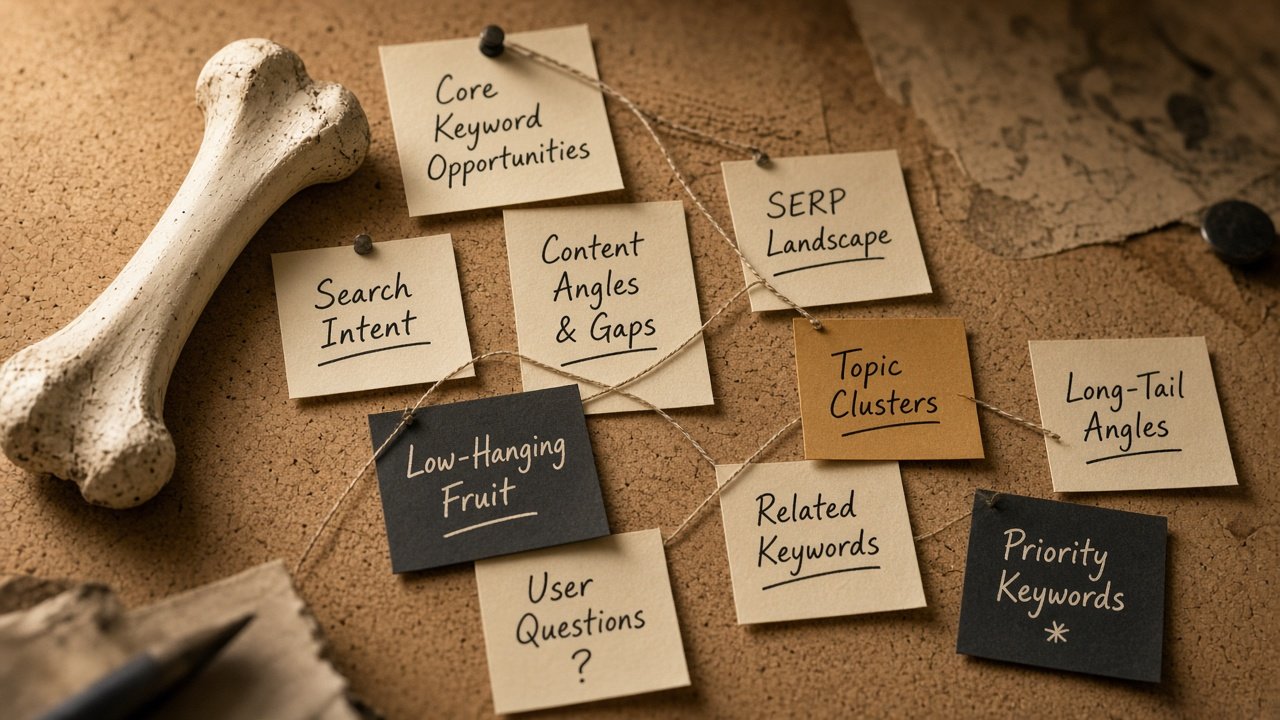
SEO keyword research is not a dump of volume metrics. It is a decision framework: which topics deserve a page, which queries share intent, and which opportunities your site can realistically win.
Seed topics from the business, not the tool
Start with offers, audience problems, and objections. Tools expand the list; they should not invent your strategy. For a copywriter, the best seeds come from:
- Sales call notes and lost-deal reasons
- Support tickets and onboarding questions
- Competitor service pages (not just their blog)
- Phrases already hiding in your website copy drafts
If a keyword cannot connect to revenue, retention, or reputation, park it.
Group by search intent
Sort candidates into informational, commercial investigation, transactional, and navigational.
| Intent | Typical page | Owner |
|---|---|---|
| Informational | Guide / explainer | Blog writing |
| Commercial | Comparison / “best” | Blog + landing |
| Transactional | Service / pricing | Website copywriting |
| Navigational | Brand / login | Site IA |
Mixing intents on one URL is how pages confuse both users and rankings.
Build topic clusters
Pick a pillar (for example, “SEO writing”) and support it with cluster posts — keyword research, meta descriptions, internal linking. Link clusters up to the pillar and across to related services.
That is Search Engine Optimization as information architecture — not as a monthly word-count target.
A keyword without a cluster is a lottery ticket. A cluster with internal links is a system.
Score opportunities like an editor
I rank opportunities on four axes:
- Relevance to revenue — does this help a buyer move?
- Intent clarity — is the SERP coherent?
- Competitive gap — can we add unique expertise?
- Feasibility — can we out-write what ranks today?
High volume with no expertise gap is a vanity project. Medium volume with a clear gap is where content writing pays off.
Hand off a brief, not a keyword list
Every SEO writing assignment should include:
- Primary keyword + secondary terms
- Intent note and SERP observations
- Must-cover H2s
- Internal link targets
- The conversion page you want traffic to reach
Without that, “optimize this draft” becomes guesswork.
A one-page research template
Primary keyword:
Intent:
SERP format winners:
What they miss:
Secondary terms:
Internal links out:
Conversion URL:
Unique angle (why us):
Fill this before anyone opens a blank document.
Connect research to publishing
Research dies when it never becomes a calendar. Pair this workflow with a blog content strategy, then draft with the habits in the SEO writing guide.